Thursday, July 15, 2010

Brazil's Bullet Train

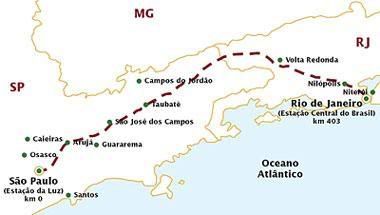
Brazil's on-again, off-again bullet train project connecting Rio de Janeiro and Sao Paulo is back on again. A rail project you ask? Ten years into the 21st century?

Yes, it's a backwards, outdated project proposing expensive passenger rail transportation at a time when air transportation is not only faster, but cheaper and more efficient. Yes, it is more of a political move rather than an infrastructure necessity. Yes, thousands of innocent families will be booted out of their homes and paid 10 centavos on the dollar (Real) in the government's eventual appropriations. Yes, Brazilian taxpayers will be footing a large chunk of the bill with no clear benefit for them. Yes, small townships located on the proposed Rio-Sao Paulo line are already fighting to have the trains stop in their municipalities, taking the speed out of the bullet.

Here are some "bullet" points:
  • Government estimated costs of US$ 18.7 billion (triple that to get true estimation)
  • The company offering the lowest fare will win the bid for the 317 mile train
  • The winning (wink, wink) consortium will be announced on December 16th, 2010
  • President Lula expects the project to be delivered in 2016, just in time for the 2014 World Cup
  • Average train speed of 177mph
  • 82 miles of trajectory through tunnels
  • Trains leaving every 15 minutes
  • Passengers per train - 855
  • Estimated time from city to city - 85 minutes
  • Projected ticket price R$ 200 each way (US$ 115)
Bookmark and Share

Monday, June 7, 2010

Tuesday News Briefs

Gay Pride = big market
Over 3 million people gathered in Sao Paulo on Sunday to attend the 14th annual Gay Pride Parade, making it the world's largest gay pride march, according to organizers. "Dancing to music blasting from sound trucks Sunday, they condemned homophobia and demanded equal rights for homosexuals. They also said they would push candidates in this year Brazil's presidential election to support their cause." The parade has the backing of the government - and get this - even has the state controlled oil company, Petrobras, as a main sponsor. Companies interested in tapping a big, big market might be wise to investigate how to become involved.

Brazil will meet deadlines for 2014 World Cup
That according to Brazil's Sports Minister, Orlando Silva, who guarantees that construction work will begin on stadiums in the second semester of this year. Despite currently having no stadiums in  Brazil that would be adequate to host a World Cup game under FIFA's standards, Silva appears to be "tranquilo" in relation to the schedule. On a personal note, I can't wait to see the final taxpayer bill for these projects, including the overcharges.

Visa-free in Russia
Monday was the first day that Russians and Brazilians no longer needed visas to visit each other's country. The Russia-InfoCentre states that "The Brazilian government is counting upon the increase of tourist traffic from Russia. Now the tourist flow is not very intensive." (Don't get your hopes up.)

Bookmark and Share

Monday, May 31, 2010

Is privatization of Brazil's air travel industry possible?

Brazil's air travel industry has all the right elements to become a world power. The country has a young population of almost 200 million people along with a rapidly expanding economy and a growing middle class. Brazil has won the rights to host not only the 2014 World Cup, but also the 2016 Summer Olympics in Rio de Janeiro. Different from the US airlines, Brazilian carriers are actually making money. Different from Europe and Japan, the airline industry doesn't have any competition in terms of trains. The BBC recently gave a shiny report (video) on Brazil's aviation sector.
With all these positives, it's hard to imagine any obstacles, right? Wrong. This 66-page government study (Portuguese) on the "Panorama and Perspectives for Air Transport in Brazil and the World" explores all facets of Brazil's air industry and gives a particularly realistic view of its challenges. One particular impediment may be that "Brazil's airports serving World Cup 2014 venues are saturated and eight are on the brink of operational collapse", including both of Sao Paulo's airports and Rio's domestic airport.
Part of the problem lies with Infraero, the Brazilian government's corporation in charge of 67 airports, 80 air navigation support units, 32 warehouse logistic terminals, and 97% of passenger and cargo air transport. Since Infraero is not a private company, it doesn't have any incentive to perform above expectations. It does its job, some of the time, and moves on, usually losing money in operations -- very similar to the US Postal Service or Amtrak.


Interestingly enough, the government study gave five options for improving the airport situation, all of them involving some sort of privatization (see p. 50), from simply privatizing Infraero, to privatizing the airports themselves.


Another obstacle mentioned was the high corporate tax rate for airline companies, close to 39% for Brazilian companies, versus 7.5% in the US - as well as the service taxes (ICMS) that vary from state to state plus abusive storage costs from the monopolistic Infraero.


What do you think will happen? Will the air industry stay in public hands? Or will a move be made towards privatization?


Bookmark and Share

Monday, May 24, 2010

Brazil's economy and the government's spending "cuts"

Two weeks ago, Brazil's Finance Minister promised what seemed like incredible amounts of budget cuts, totaling R$10 billion, in response to the country's "overheating" economy - without affecting social programs or infrastructure investment. The press, Brazilian and international alike, fell for it - hook, line and sinker - and thus made no investigations into its veracity.

Meanwhile, Leandro Roque had the crazy idea of actually looking up the budget figures and seeing how the government planned to cut R$10 billion in an election year. Interestingly enough, Mr. Roque discovered that the "approved" budget from 2009 to 2010 increased by R$168 billion. So the "cuts" are actually an increase of R$158 billion. Nice.

The Economist published a story last week entitled "Flying too high for safety".

NEW skyscrapers are going up along Avenida Faria Lima in the business district of São Paulo. Sales of computers and cars are booming, while a glut of passengers has clogged the main airports. Brazil created 962,000 new formal-sector jobs between January and April—the highest figure for these months since records began in 1992. Everything indicates that over the past six months the economy has grown at an annualised pace of over 10%. Even allowing for an expected slackening, many analysts forecast that growth in 2010 will be 7%—the highest rate since 1986.
The problem is that while it may be growing at Chinese speeds, Brazil is not China. Because it still saves and invests too little, most economists think it is restricted to a speed limit of 5% at the most, if it is not to crash. The growth spurt is partly the result of the stimulus measures taken by President Luiz Inácio Lula da Silva’s government when the world financial crisis briefly tipped the country into recession late in 2008. The trouble, say critics, is that much of the extra government spending is turning out to be permanent—and so the economy is starting to resemble a Toyota with the accelerator stuck to the floor.
The government is still injecting money into the economy in two controversial ways. First, the National Development Bank (BNDES), whose loans cost about half the Selic rate, has expanded its lending by almost half. It has been able to do this because the treasury granted it two long-term credits totalling 180 billion reais. Those credits, for which the BNDES has offered IOUs, have led to accusations of creative accounting. While adding to the government’s gross debt, they have not driven up the more closely watched figure for public debt, net of assets: at 42.7% of GDP, this is back to its level of mid-2008, and is much lower than the debt burdens of European countries.
Second, the government has jacked up its payroll spending. The number of federal civil servants has increased fairly modestly since 2003 (by around 10%). But they have been treated generously: the total federal wage bill more than doubled in nominal terms between 2003 and 2009, while inflation was less than 50%. Lula has pushed up the minimum wage much faster than inflation too. That has helped to make the income distribution less skewed, and boosted consumer demand. But it has a knock-on effect on pension benefits.
What's the bottom line? Well, Brazil is indeed growing quickly, no doubt about that. But it seems to be doing so without making any real structural change. There have been no reductions in the sky-high importation duties. There have been no reductions in runaway government spending. Corruption continues to haunt both companies and individuals. And it's difficult to do business in Brazil - which is ranked #129 in ease of doing business, just ahead of Lesotho and Tanzania. How long will the party last?

Bookmark and Share

Wednesday, May 19, 2010

Thursday news

Looking to invest in an island?
According to Exame's article, there are several islands for sale off the Brazilian coast. Ilha das Couves in the state of Sao Paulo is the biggest bargain of the bunch, starting at only R$12 million (US$ 6.5 million). According to the sales literature, it's a "true paradise with no big storms, snakes or large mosquitos."  Meanwhile, the most expensive Brazilian island, located in the state of Bahia, goes for a cool R$ 41 million (US$ 22.3 million).


8.5% growth?
Businessweek is reporting that Itau Bank may raise it's growth forecast for Brazil to 8.5% this year. That's approaching Chinese levels! Economists are notoriously famous for missing the mark on economic predictions, but Brazil's economy has been on fire this year. "Citing the growth of employment, expanding retail sales and bank lending as signs that the economy may grow faster than now expected, economist Guilherme da Nobrega said that 'the theme in Brazil is really the risk of overheating.'”

Chic Shopping Mall
To take advantage of increased consumer spending, yet another high-class shopping mall should be completed by 2011 in the Vila Olimpia region of Sao Paulo. Just two years after the opening of the luxurious Shopping Cidade Jardim, located on the other side of the Pinheiros river, JK Iguatemi will try and top it. In a joint development between W Torre and Grupo Jereissati, the 4 level shopping mall plans to attract the world's best luxury brands with over 200 stores (including a 3000 sq. meter Daslu), an international top-of-the-line hotel, and 20,000 expected daily visitors. Some of the expected luxury brands include Louis Vuitton, Prada, and Bottega Veneta.


Bookmark and Share

Monday, May 17, 2010

Why are cars in Brazil so expensive?

Good article from Exame (in Portuguese) regarding the extremely high price of cars in Brazil. Some points from the article:

- Taxes, labor costs, raw materials and lack of infrastructure force Brazilians to pay double what Mexican consumers pay for the same car

- The basic model of the Honda City is sold in Brazil for the equivalent of US$ 32,000 (according to mid-May exchange rates). Considering the car's category, the price is similar to that of its competitors. Rival sedans like the Volkswagen Polo, Fiat Linea and Ford Focus cost between US$ 28,000 and $33,500. What not everybody knows is that crossing the border into Argentina, the same car with several accessories - such as electric power steering, onboard computer and dual airbags - can be purchased for US$ 20,100.

- The price difference in itself is already strange, but what makes it even harder to swallow is that both the car sold in Argentina and the one sold in Brazil come from the same production line in Sumare, located in the state of Sao Paulo. The import cost is zero for the Mercosur neighbors. The biggest explanation for the price difference is the weight of Brazilian taxes.

- Together the Brazilian taxes IPI, ICMS, PIS and Cofins represent between 27 and 36% of the total value of automobiles. For comparison's sake, in the US, taxes add up to about 6.1% of the vehicle's final price.

- The disparity suggests that vehicle produced abroad could invade Brazil. But it's a mistake to think that the tax burden offers relief to imports. Insurance, freight, and a 35% import duty are added to the price of each imported car. Next, the car collects all taxes paid on its home soil which are not charged in the country of origin. According to Abeiva, the Association of Importing Companies, the math makes it clear: by the time the car reaches the Brazilian consumer, it will cost 2.7 times its original price.

- Not only is the purchase price higher than almost every other country, but financing (avg of 25%/year), ownership, and maintenance costs also make Brazil champion of high prices.

- The government is not keen to change its tax policy because it makes so much money. In 2009, it charged over US$ 15.7 billion in taxes from autos.

- Despite the obstacles, the Brazilian auto industry is having the best times in its history. 3.4 million vehicles are expected to sell in 2010 and investment is at record levels.

- If you read this story and are willing to travel to Argentine to enjoy a delicious wine, a juicy chorizo steak and come back with a Honda city purchased at a US$12,000 discount, forget about it. To cut off this potential tax evasion, the Brazilian government prohibits the importation of any vehicle that doesn't come straight from the factory - except those used in diplomatic missions and cars over 30 years old. And you can only drive a foreign vehicle in Brazil for a maximum of 180 days. The only solution is to accept the high prices charged here.

My takes:

  • Things are even more expensive than they seem. The annual car ownership tax is 4% of the government estimated car value, which is always higher than what you think it's worth. So the owner of a domestically manufactured 2004 Toyota Corolla would pay approximately US$ 780, while the owner of an imported 2010 BMW X6 would pay over US$ 7000 in yearly ownership tax.
  • Gas is more expensive than in the US, currently costing over 5 dollars a gallon in Sao Paulo.
  • Load up at the ATM before heading out on the highway. A quick 5 hour trip from Rio de Janeiro to Sao Paulo will cost you US$ 28 each way in tolls. Credit/debit cards are not accepted.
  • It's amazing to me that Brazilians - 1) Are able to afford to drive given the tremendous associated costs, and 2) Still put up with these outrageous duties and taxes.

Bookmark and Share

Wednesday, May 12, 2010

Brazil a middle class country - almost

According to several reports, including these in the WSJ and Exame, Brazilian Finance Minister Guido Mantega said Wednesday that Brazil's economy has embarked on a long-term cycle of growth and won't be subject to a bubble. "We have $250 billion in foreign reserves and we are vaccinated against crisis", he said. Mantega thinks inflation is under control and the country will grow between 5.5% and 6% this year. He also expects Brazil to create 2 million jobs in 2010.  "You can almost confirm" that Brazil is now a middle class country, due to government estimates that 50% of the population falls in the C socioeconomic class. Sounds pretty good, right?


My takes:
  • While Brazil's growth prospects and economic situation are currently in favorable situations, investors can't take everything they hear as the absolute truth. The Finance Minister of any country is going to try and "sell" his/her country's growth prospects to attract more investment. 
  • Mantega just totally jinxed the economy by saying "we are vaccinated against crisis"! What's the over/under for some far-off international incident (take your pick among a- terrorist attack in the Philippines b-debt crisis in eastern Sudan c- negative US job growth d- anything else you can think of)  to cause Brazil's economy to tank?
  • "Almost" a middle class country? And I was almost a professional basketball player. And Cuba is almost a free market society. Better stop here. Like shooting fish in a barrel.
  • Never, ever trust a guido in a high governmental position.

Bookmark and Share